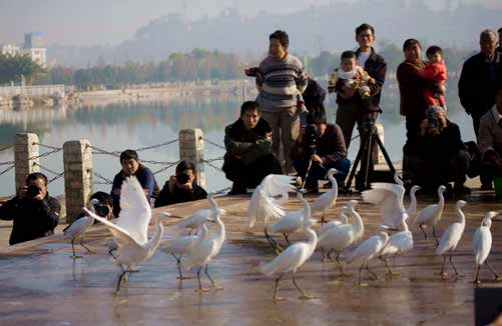
Birders take photos of egrets along the Yuxi River, Yuxi, Yunnan Province, January 24, 2010 (Photo by VCG)
Yunnan Province hosts China’s richest bird habitats and avian diversity. Nearly 40 percent of China’s over 250 birdwatching sites lie in Yunnan, making it a leader in the burgeoning industry.
Through managing artificial bird ponds, resource sharing and local wisdom, its model has given mountain villagers who once hunted birds the chance to become wildlife guardians, creating an eco‑friendly sector driven by community.
Wu Fei is a long‑standing expert on avian ecology. An associate researcher at the Chinese Academy of Sciences Kunming Institute of Zoology, he is spearheading the introduction of the nation’s first provincial‑level birdwatching standards.
In our exclusive interview, Wu shared his thoughts on the opportunities, risks and long‑term outlook for birdwatching, and what that means for the future of eco‑tourism.
NewsChina: What impact has the boom in birdwatching brought to wildlife habitats and rural communities?
Wu Fei: In recent years, birdwatching has grown quickly in China and attracted more people across the country. But overall, the sector is still in its early stages, developing mainly through spontaneous local efforts. Unified industry standards and top‑level overall planning are still absent, yet the overall industrial foundation has been firmly established.
Survey data shows that the number of bird pond sites nationwide exceeded 250 several years ago and it continues to expand. Thanks to its unique ecological endowments and abundant bird resources, Yunnan has the most concentrated bird resources and the most mature birdwatching industry in China.
As a distinctive eco‑industry, birdwatching has shown that conservation and rural development can go hand in hand. In the past, wild birds were an important protein source for ethnic communities in the remote mountains of Yunnan. Today, businesses including bird pond operation, bird guiding, rural homestays and catering services provide villagers with stable and sustainable sources of income.
The industry has fundamentally transformed local people’s awareness and livelihoods. Former bird hunters have turned into active forest and habitat guardians, voluntarily protecting wild birds. The substantial improvement in villagers’ conservation awareness has greatly reduced pressures on nature reserves and strengthened grassroots ecological conservation.
In villages such as the mountainous Baihualing in the city of Baoshan and Shiti in Yingjiang County, Dehong Dai and Jingpo Autonomous Prefecture, the six‑month birdwatching peak season alone generates considerable household incomes. Meanwhile, it drives supporting industries including produce sales and transportation, equipment maintenance and nature education, enabling the whole village to share in the dividends of ecological resources.
The bird pond model provides an innovative solution to the dilemma of ecological protection and economic development in remote mountain areas. It effectively helped villagers lift themselves from impoverishment during China’s poverty alleviation campaign. Now, its eco‑friendly and people‑centered approach pairs with China’s rural revitalization strategy.
Practice has proven that the bird pond model forms a sustainable green development system. It activates the ecological value of rural resources, boosts rural revitalization and continuously safeguards regional biodiversity, organically integrating ecological protection, livelihood improvement and rural development.
NC: Some worry that bird ponds and supplementary feeding could harm wild bird populations. Are those concerns justified?
WF: Public anxiety over bird ponds largely centers on risks associated with supplementary feeding. Critics fear constant provision of food will modify wild birds’ instinctive behavior, foster food dependency and disrupt natural population cycles. But research conducted at birdwatching ponds in Yunnan shows the adverse effects of properly managed artificial feeding are relatively minor and controllable.
Yunnan has dry and wet seasons. Most bird ponds follow a six‑month open, six‑month closed schedule.Between October‑November and April‑May, the dry season creates water and wild food shortages. Bird ponds supply water and moderate supplementary feed to offset these deficits. All feeding stops from late May to late September during the wet season, pushing birds back to full natural foraging. Temporary behavioral changes caused by human activity gradually subside.
Seasonal supplementary feeding in Yunnan is similar in some ways to established practices in other countries, such as backyard bird feeding. In both cases, people provide food to birds to attract them for greater birdwatching opportunities. However, feeding at bird ponds is typically seasonal and is combined with measures like replenishing water, providing concealed viewing areas and following standardized management. This makes it quite different from backyard bird feeding, which is often year‑round. Research suggests that carefully controlling the amount of food provided and how feeding is managed can help prevent birds from becoming over‑reliant on artificial food sources. So far, no evidence has been found that moderate supplemental feeding leads to significant changes in bird community structure.
Baihualing, a well‑established site, hosts just over 20 bird ponds with tightly controlled scale. Long‑term monitoring detects no significant shifts in either the species richness or community composition of local bird populations.
We’ve documented positive outcomes for multiple nationally protected pheasants such as the grey peacock‑pheasant and Kalij pheasant. Notably, the Class I protected grey peacock‑pheasant has seen considerable population growth, with no detectable disruption to its habitat selection or breeding caused by bird ponds. In summary, standardized bird ponds improve breeding output among medium and large wild pheasants and help populations of threatened avian species recover. The model serves as a viable solution for Southwest China’s mountain landscapes.
NC: Baihualing and Shiti are often cited as successful examples of birdwatching‑driven rural development. What makes their model work, and what should other regions avoid when trying to replicate it?
WF: The villages’ sustained growth hinges on community‑led governance with co‑development and shared benefits.
Both communities endured chaotic unregulated early development. Initially, a handful of villagers controlled bird pond resources and captured most of the profits, shutting out the majority. Widening inequality sparked frequent conflicts over resources.
Locals came to recognize birds depend on whole forest ecosystems rather than separate ponds. Profit concentration among a few was unsustainable and risked retaliatory ecological damage. Through self‑governance, they built a collective revenue‑sharing framework.
Bird pond operators now allocate part of their earnings to a communal ecological fund. The fund covers village infrastructure upkeep, forest management, sanitation and unified ticketing. Year‑end surpluses are divided equally among all villagers. This multi‑stakeholder system stabilizes the industry. Operators retain viable profits, while other residents earn money through bird guiding, transport, homestays, catering and selling local goods. Even local non‑participants receive annual ecological dividends, further reducing disputes.
Yunnan’s ethnic villages have tight kinship networks and a strong collective consciousness that aid in sharing benefits. The model has attracted delegations from other provinces in China to visit and study it, hoping to draw inspiration from it.
But two key principles must be followed to replicate it successfully. First, local villagers must have the leading role and outside capital cannot monopolize the space. The birdwatching economy is a niche eco‑industry reliant on intact natural habitats. Large external investment, over‑commercialization and drastic changes to the landscape harm native ecosystems, crowd out local livelihoods, fuel social friction and betray the goal of ecologically driven rural prosperity.
Second, policies and distribution rules must be tailor‑made. Regions vary widely in customs, demographics, development foundations and public expectations. Enforcing uniform formulas could trigger new village tensions. A reasonable income distribution system is also vital. Excessive wealth gaps between bird pond operators and other villagers could breed resentment and destabilize communities.
Nationwide, the birdwatching industry remains exploratory and lacks unified national top‑down rules. Its strength lies in flexible grassroots governance. Given China’s vast regional diversity, any national standards will require local adjustment. The benchmark for assessing rural industrial models is institutional fairness and public acceptance, alongside tangible ecological and livelihood gains, rather than rigid rules and regulations.
The broader industry rejects compulsory standardized pricing, revenue allocation and operating rules. Respecting organic, locally evolved practices aligns with industrial realities. Local governments and nature reserves fulfill supportive, supervisory and guiding functions while preserving room for grassroots innovation.
NC: What role does local ecological knowledge passed down through generations play in the birdwatching industry?
WF: Communities that have lived in these mountains for centuries have inherited a complete set of indigenous ecological wisdom forged through generations of coexistence with nature. They know exactly which tree species each bird favors, their seasonal activity ranges and hidden roosting spots. This intuitive, place‑based knowledge cannot be quickly acquired by outside researchers and bird enthusiasts, and makes up the core competitiveness of local bird guides.
Nevertheless, this valuable traditional knowledge has yet to be systematically sorted and cataloged, and there are few dedicated studies measuring its practical value within the birdwatching sector. Going forward, we can standardize the archiving of these ecological insights and integrate them into the full spectrum of wildlife conservation and bird pond management to fully unlock the potential of their experience for the birdwatching economy.
NC: Yunnan is drafting new guidelines for birdwatching activities and bird pond management. What will these standards mean for the industry’s future development?
WF: Few rural industries deliver steady, direct income to ordinary villagers in remote mountain regions. The birdwatching economy is emerging as a practical eco‑industry based around communities.
Unlike mainstream cultural tourism, the bird pond model creates a distinctive framework where ecological protection, rural income growth and streamlined ecological governance improve together.
But because the sector depends on unique wildlife resources and high‑quality habitats, unregulated expansion is not conducive to its healthy and sustainable development. To address demand for standardized practices in the industry, Yunnan provincial authorities commissioned me to lead the drafting of provincial birdwatching tourism plans, industry guidelines and construction specifications.
Currently, our team is working to finalize the compilation of the Standards for Bird Pond Construction and the Yunnan Province Guidelines for Birdwatching.
Importantly, the new rules avoid rigid, universal numerical mandates such as fixed feed amounts, uniform pond spacing or set photography distances. Bird behavior shifts with seasons, climate and resource availability, rendering static figures unsuitable for diverse ecosystems. Precise regional quantitative thresholds require further targeted research.
Current regulations center on three core ecological and safety bottom lines. First is facility safety standards. Many Yunnan bird ponds are in remote mountainous areas, with steep terrain, posing certain safety risks. Specifications set requirements for viewing hides, platforms and trails to mitigate fall hazards.
The second is wildfire prevention and sanitation rules. Peak birdwatching time coincides with Yunnan’s high‑risk dry season. The standards tighten fire control and standardize waste management to safeguard forest ecosystems.
Third comes scientific feeding protocols. Permanent year‑round feeding is explicitly banned. Operations should follow seasonal cycles, with supplementary feeding concentrated in dry seasons. Permitted foods include mealworms, grains and fresh fruit matching birds’ natural diets. Hazardous feed threatening avian health and ecological balance is prohibited.
The provincial standard establishes a foundational framework. No unified, mature international standards exist for bird pond construction and management. Yunnan’s emerging provincial standards will steer orderly development across China and offer actionable local experience for global eco‑industry governance.
NC: Birdwatching is highly seasonal. How are communities in Yunnan creating more stable, year‑round sources of income?
WF: Seasonal fluctuation is intrinsic to birdwatching. The six‑month feeding cycle safeguards the ecology and reduces the likelihood of dependence on supplementary food, so intensive year‑round operations are inadvisable. To counter unstable seasonal revenues, established birdwatching villages across Yunnan have adopted integrated “birdwatching plus” models, easing over‑reliance on a single sector and boosting off‑season earnings.
Three sustainable revenue pillars have emerged. First, nature education and research: Hubs such as Baihualing engage seasoned local bird guides to deliver immersive programs including night insect observation and ornithology outreach. These attract families and student study tours, filling the off‑season tourism gap and smoothing annual business volumes. Second, integrated agritourism: Regions around Baoshan have launched distinctive “birdwatching plus coffee” itineraries tied to canopy farming. Local produce and ethnic handicrafts are marketed alongside tourism, converting visitor flows into diversified agricultural income. Third, year‑round auxiliary services: Homestays, local catering and short‑distance transport operate independently of birdwatching seasons, delivering permanent village employment.
Diversification gradually reduces villagers’ over‑dependence on bird photography revenue and builds a more robust rural industrial system. In Baihualing, several young residents have returned from cities to run study tour and cultural tourism programs. Still, the number of returnees remains limited. Most are relatives of leading operators. For most villagers, urban employment offers more reliable income than the local birdwatching trade.

People view red-billed gulls at Yilong Lake, Shiping County, Honghe Hani and Yi Autonomous Prefecture, Yunnan Province, December 25, 2023 (Photo by VCG)
NC: Looking ahead, what would an ideal birdwatching industry look like in Yunnan, and what are the biggest challenges to achieving it?
WF: Yunnan hosts over 1,000 bird species, China’s richest avian diversity. Its optimal development framework has three pillars. First, streamlined resource management: Authorities should catalogue prefecture‑level flagship birds such as green peafowl and great hornbill, document stable viewing periods and create standardized birdwatching route guides to support independent types of visitors.
Second, professional services: Yunnan needs to train local expert bird guides equipped with regional ornithological and conservation knowledge, alongside varied lodging from budget inns to premium eco‑homestays, to serve diverse visitors.
Third, coordinated cross‑regional development: Following provincial guidelines, interconnected tourism loops with complementary wildlife resources can redistribute visitor traffic across prefectures, uniting avian resources to build nationally famous birdwatching brands.
Major constraints limiting growth exist in physical and service infrastructure. Physically, most bird sites occupy remote mountains with difficult transport. Service‑wise, there are no formal training systems for bird guides.
Research on local feeding regimes and carrying capacity (how many visitors a region can support) remains inadequate, while cross‑prefecture and interprovincial route coordination progresses need to be strengthened.
NC: As Yunnan develops more high‑end birdwatching routes, how can it balance tourism, scientific research and wildlife protection?
WF: I believe the key is to build a virtuous cycle where birdwatching tourism, scientific research and wildlife conservation reinforce one another, rather than being treated as competing interests.
First, high‑quality birdwatching tourism generates direct economic benefits for local communities. This economic incentive naturally raises residents’ awareness of conservation. When birds become a sustainable source of income, protecting them becomes a shared community interest rather than an external mandate. At the same time, well‑guided birdwatching activities serve as a form of public science education, helping visitors understand the ecological value of these species and fostering a broader culture of conservation.
Second, birdwatchers produce valuable scientific data, such as species distribution records, population trends and seasonal migration patterns. This data often covers large areas over time that professional researchers alone cannot achieve.
Third, research based on this data enables scientists to develop evidence‑based conservation strategies, such as identifying priority protection zones, understanding population dynamics or assessing the impacts of environmental changes. More effective conservation leads to healthier bird populations and more diverse species, which makes birdwatching destinations more attractive, drawing more tourists and generating further economic returns.
In this way, tourism fuels conservation motivation, conservation enables scientific data collection, science informs better protection measures and better protection sustains the very resource that makes tourism viable. It is a self‑reinforcing loop where each pillar strengthens the others.
(原载于《中国新闻周刊》英文版 2026年9月刊 封面报道)


 滇公网安备 53010202000920号